publications
all publications can be found on my arXiv page.
2026
-
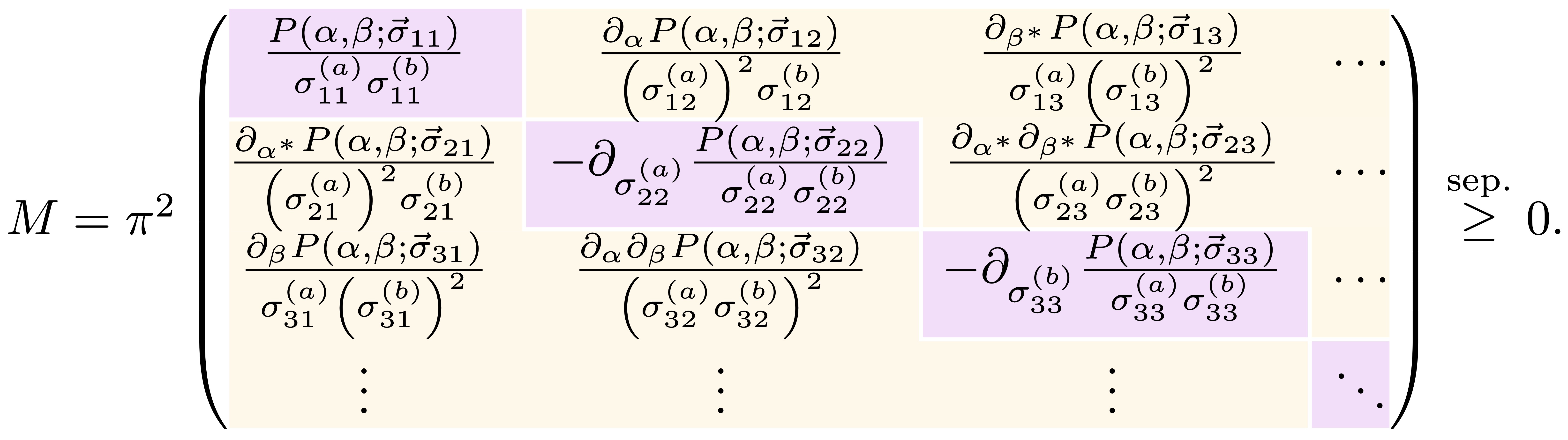 Revealing entanglement through local features of phase-space distributionsElena Callus, Martin Gärttner, and Tobias Haas
We formulate an infinite hierarchy of continuous-variable separability criteria in terms of quasiprobability distributions and their derivatives evaluated at individual points in phase space. Our approach is equivalent to the Peres–Horodecki criterion and sheds light on how distillable entanglement manifests in the phase-space picture. We demonstrate that already the lowest-order variant constitutes a powerful method for detecting the elusive non-Gaussian entanglement of relevant state families. Further, we devise a simple measurement scheme that relies solely on passive linear transformations and coherent ancillas. By strategically probing specific phase-space regions, our method offers clear advantages over existing techniques that rely on access to the full phase-space distributions.
2025
-
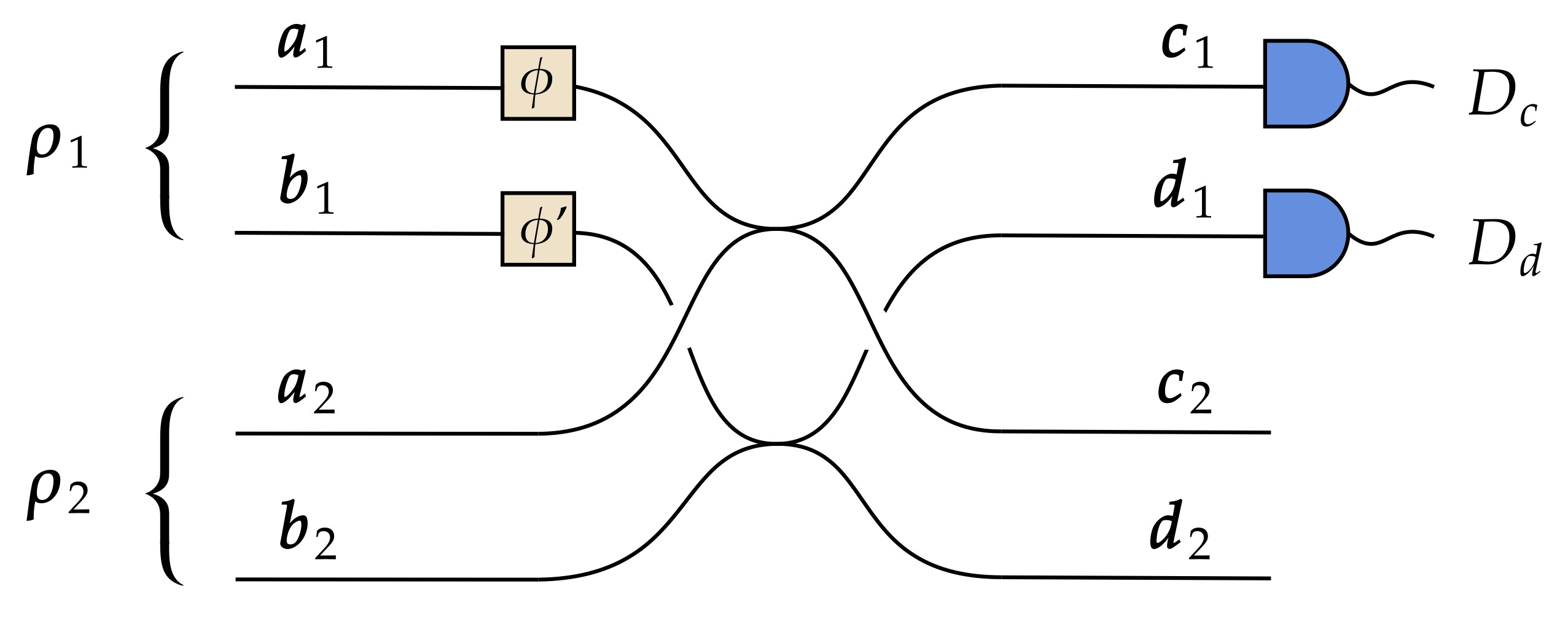 Interferometric detection of continuous-variable entanglement using two statesElena Callus, Martin Gärttner, and Tobias Haas
The efficient witnessing and certification of entanglement is necessitated by its ubiquitous use in various aspects of quantum technologies. In the case of continuous-variable bipartite systems, the Shchukin–Vogel hierarchy gives necessary conditions for separability in terms of moments of the mode operators. In this work, we derive mode-operator-based witnesses for continuous-variable bipartite entanglement relying on the interference of two states. Specifically, we show how one can access higher moments of the mode operators, crucial for detecting entanglement of non-Gaussian states, using a single beamsplitter with variable phase and photon-number-resolving detectors. We demonstrate that the use of an entangled state paired with a suitable reference state is sufficient to detect entanglement in, e.g., two-mode squeezed vacuum, NOON states, and mixed entangled cat states. We also take into account experimental noise, including photon loss and detection inefficiency, as well as finite measurement statistics.
-
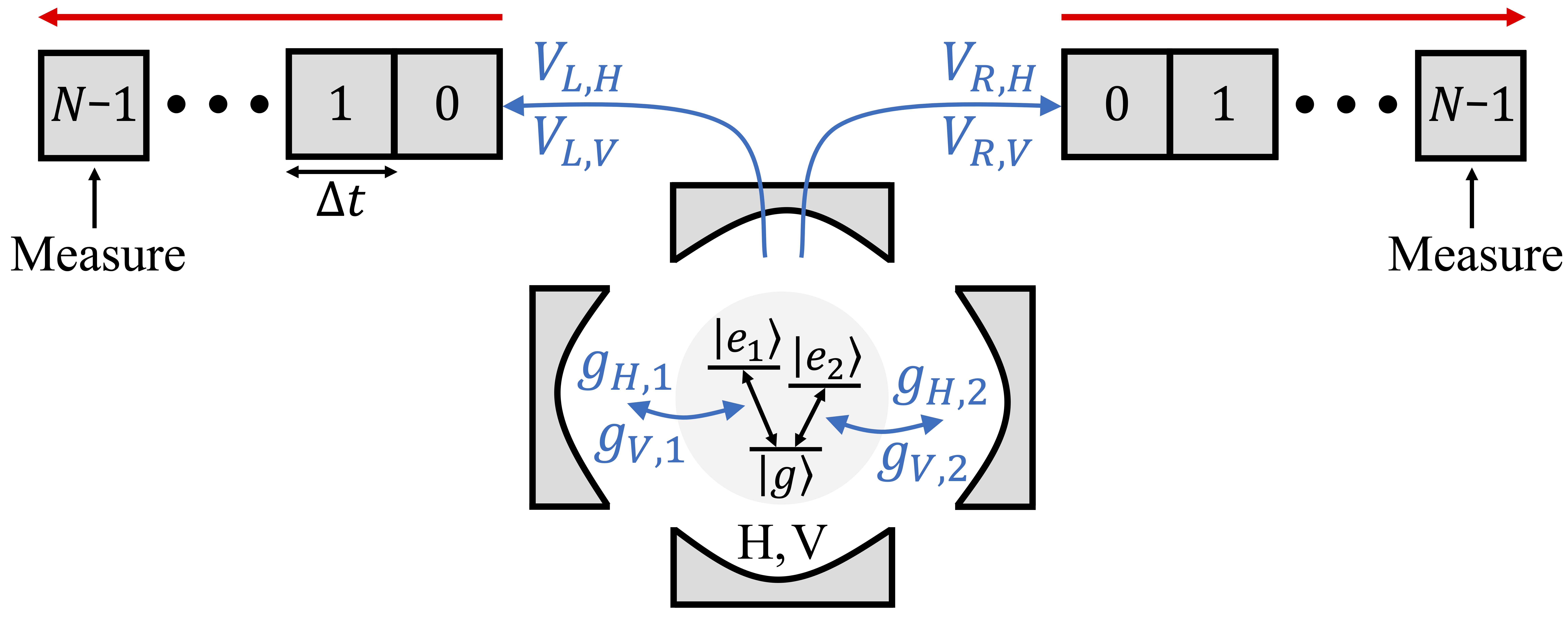 Purcell-enhanced, directional light–matter interaction in a waveguide-coupled nanocavityNicholas J. Martin, Dominic Hallett, Mateusz Duda, Luke Hallacy, Elena Callus, Luke Brunswick, René Dost, Edmund Clarke, Pallavi K. Patil, Pieter Kok, Maurice S. Skolnick, and Luke R. Wilson
We demonstrate electrically tunable, spin-dependent, directional coupling of single photons by embedding quantum dots (QDs) in a waveguide-coupled nanocavity. The directional behavior arises from direction-dependent interference between two cavity modes when coupled to the device waveguides. The small-mode-volume cavity enables simultaneous Purcell enhancement (10.8±0.7) and peak directional contrast (88±1%), exceeding current state-of-the-art waveguide-only systems. We also present a scattering matrix model for the transmission through this structure, alongside a quantum trajectory-based model for predicting the system’s directionality, which we use to explain the observed asymmetry in directional contrast seen in QD devices. Furthermore, the nanocavity enables wide-range electrical tuning of the emitter’s directional contrast. We present results showing precise tuning of a QD emission line from a directional contrast of 2%–96%. In combination, these characteristics make this cavity–waveguide approach promising for use as a building block in directional nanophotonic circuits.
2023
-
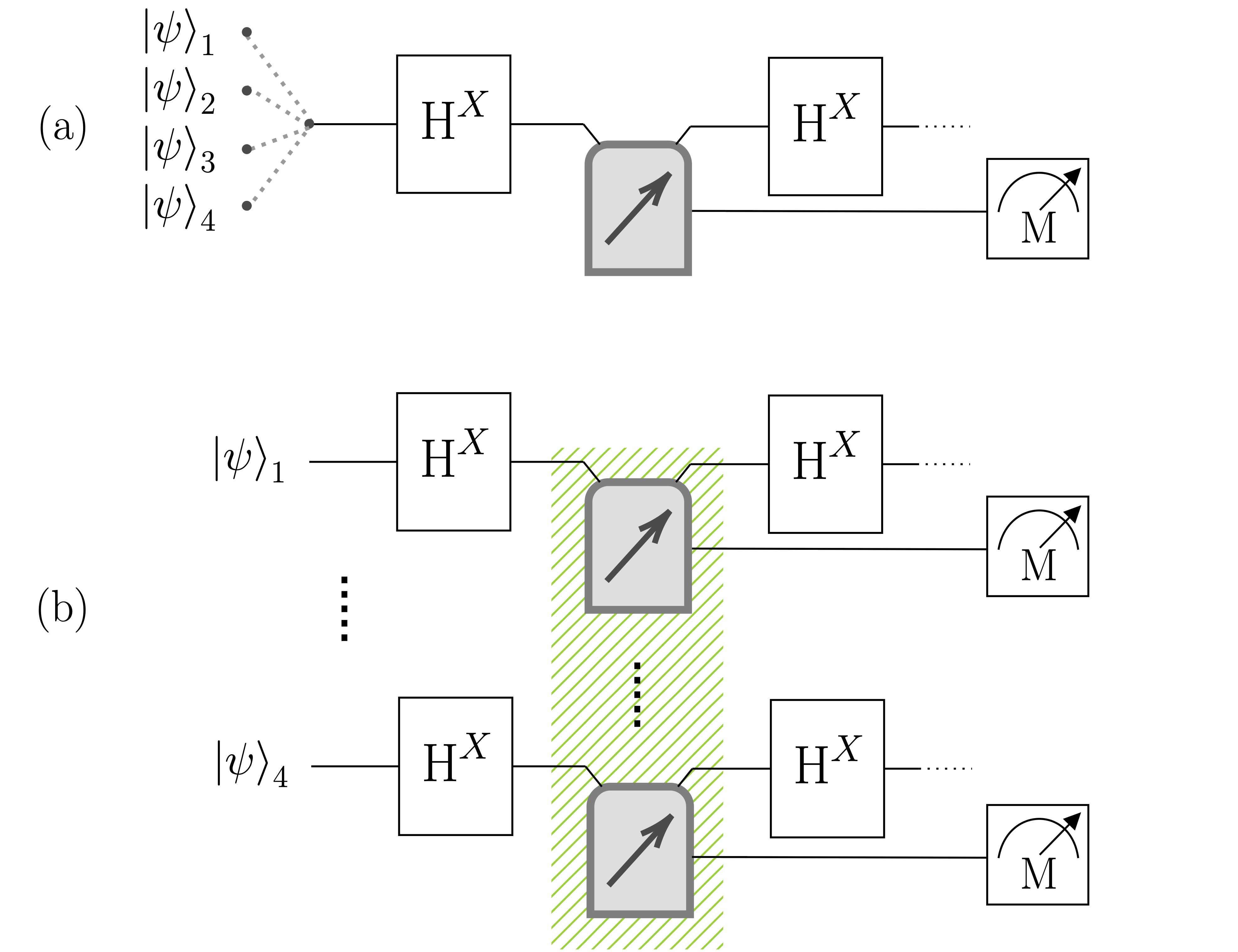 Spin-augmented observables for efficient photonic quantum error correctionElena Callus and Pieter Kok
We demonstrate that the spin state of solid-state emitters inside micropillar cavities can serve as measure qubits in syndrome measurements. The photons, acting as data qubits, interact with the spin state in the microcavity and the total state of the system evolves conditionally due to the resulting circular birefringence. By performing a quantum non-demolition measurement on the spin state, the syndrome of the optical state can be obtained. Furthermore, due to the symmetry of the interaction, we can alternatively choose to employ the optical states as measure qubits. This protocol can be adapted to various resource requirements, including spectral discrepancies between the data qubits and codes with modified connectivities, by considering entangled measure qubits. Finally, we show that spin-systems with dissimilar characteristic energies can still be entangled with high levels of fidelity and tolerance to cavity losses in the strong coupling regime.
2021
-
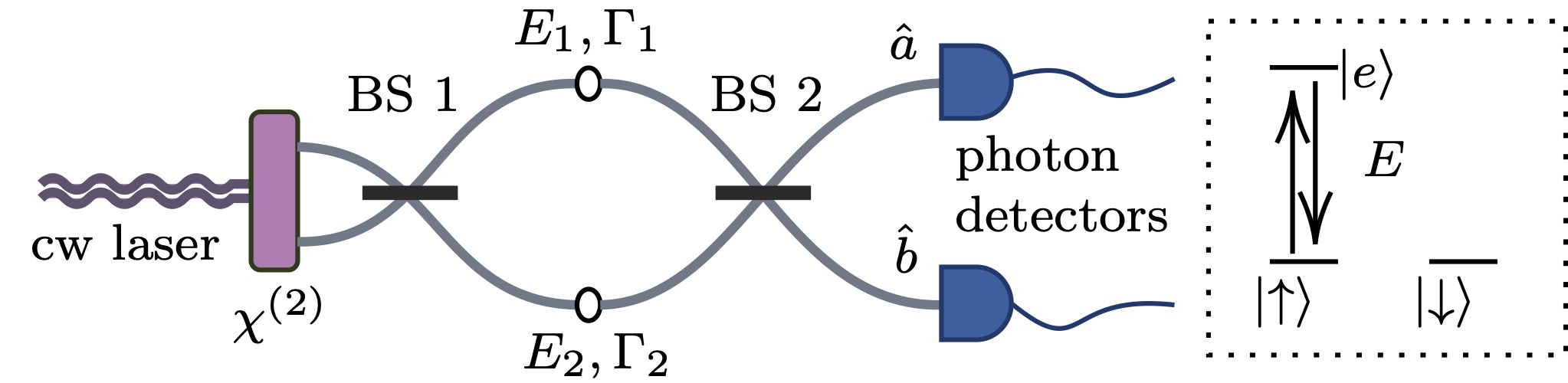 Cumulative generation of maximal entanglement between spectrally distinct qubits using squeezed lightElena Callus and Pieter Kok
We demonstrate how to create maximal entanglement between two qubits that are encoded in two spectrally distinct solid-state quantum emitters embedded in a waveguide interferometer. The optical probe is provided by readily accessible squeezed light, generated by parametric down-conversion. By continuously illuminating the emitters, the photon scattering and incremental path-erasure builds up entanglement. Our method does not require perfectly identical emitters, and accommodates spectral variations due to the fabrication process. Furthermore, for some line-width and energy ratios, the entanglement build-up can be significantly faster than for more similar emitters. It is also robust enough to create entanglement with a concurrence above 99% in the event of scattering losses and detector inefficiencies, and can form the basis for practical entangled networks.